
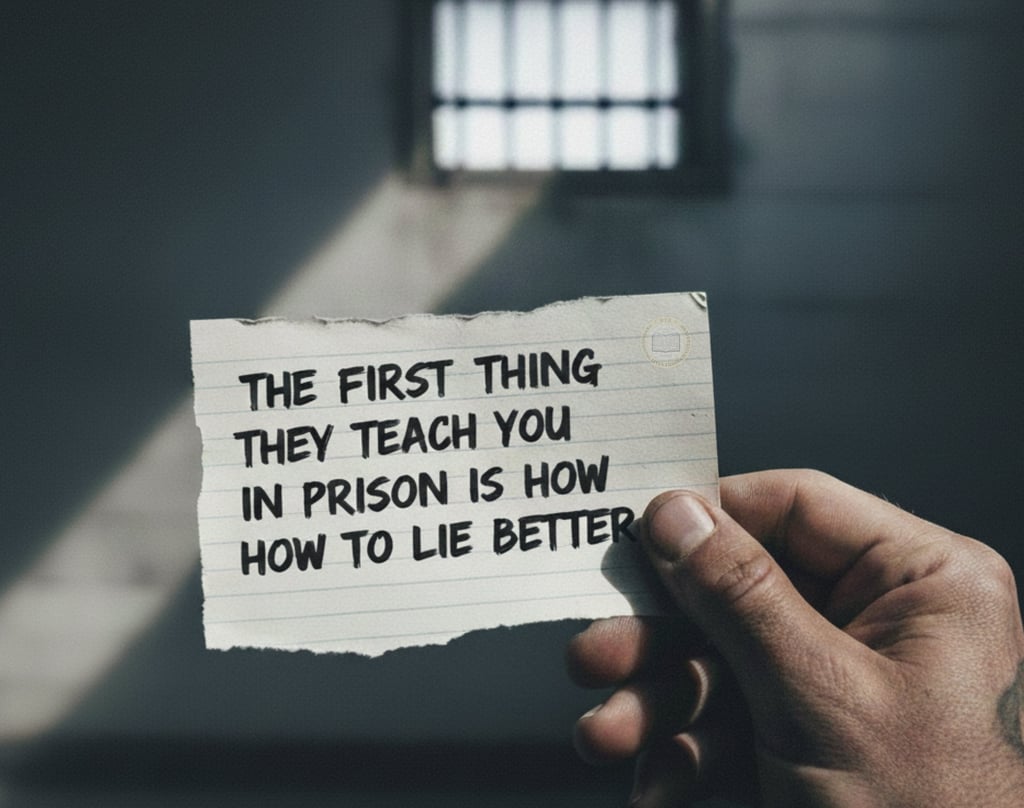
The First Thing They Teach You in Prison Is How to Lie Better
This insight exposes how prison and mandated programs train people to perform change instead of actually transforming, rewarding scripted remorse and compliance over real honesty and growth. It argues that this performance culture makes recidivism predictable, then contrasts it with CTG’s writing-based framework, which forces genuine self-examination, builds internal structure, and creates conditions where people can think differently instead of just “lying better.”
T.M. Jefferson | www.ctgpro.org
1/3/20267 min read
Not officially. Not in a handbook. Not in orientation.
But through every program, every intake form, every counseling session, you learn it fast: tell them what they want to hear. Perform insight. Show remorse on cue. Master the language of transformation without actually changing.
This is what prison prepares you for. And it's why recidivism is inevitable.
You Learn the Script Early
Week one. Substance abuse class. The facilitator asks, "Do you understand how your choices led you here?"
You nod. You say yes. Because that's the right answer. Not because you've examined your thinking. Not because you've traced the pattern back to its origin. Not because you understand the gap between intention and action. You say yes because saying no gets you flagged. And getting flagged means more time, more scrutiny, more obstacles between you and the door.
So you learn the script. "I take full responsibility." "I see where I went wrong." "I'm committed to change." You say it in group therapy. In one-on-ones with case managers. In letters to parole boards. You say it so many times you start to believe you believe it. But you don't. Because belief requires examination. And examination requires honesty. And honesty gets you punished in places designed for control, not transformation.
Performance Becomes Survival
The game is simple. Show up. Don't cause problems. Say the right things at the right time. Complete the checklist. Don't question the program. Don't challenge the framework. Don't point out that the anger management class never asked why you were angry in the first place. Just perform.
Perform reflection. Perform accountability. Perform growth. The system doesn't care if it's real. It cares if it's documented. So you give them what they need: compliance wrapped in the language of transformation. And they reward you for it. Early release. Reduced supervision. A letter to the judge that says you "engaged meaningfully with programming." You didn't engage meaningfully. You survived strategically. But the system calls that success.
Rehabilitation Is Theater
Let me be clear. Most people inside want to change. They're not resisting transformation. They're resisting performance. Because they've learned the difference.
Real change is internal, uncomfortable, and slow. It requires you to confront the stories you've told yourself about who you are and why you do what you do. It requires you to sit with the gap between who you say you are and who you actually are when no one's watching. That work is hard. And it doesn't fit neatly into 12-week modules or compliance-based curricula.
So instead, the system offers theater. Sit in this class. Fill out this worksheet. Tell us you've learned something. We'll check the box. You'll move through the system. Everyone wins. Except no one does. Because the moment pressure returns, and it always returns, people revert to the patterns they never examined in the first place. Not because they didn't try. Because the system never gave them tools to do anything but perform.
The System Teaches You to Game It
Here's what's insidious. The system doesn't just fail to create change. It actively trains people to fake it.
Every time you learn to say the right thing without meaning it, you're learning to distrust your honesty. Every time you perform insight to satisfy a checklist, you're learning that truth is less valuable than compliance. Every time you master the language of transformation without doing the internal work, you're learning that change is something you demonstrate, not something you live.
And then they release you. With no internal structure. No framework for examining your thinking. No tools for interrupting patterns under pressure. Just the script. And the script doesn't work when you're back in environments that don't care what you said in group therapy.
So you fail. You cycle back. You sit in the same programs again. You say the same things again. And the system calls this recidivism. As if the problem is you. As if you're resistant. As if you lack motivation or discipline or insight.
The problem isn't you. The problem is that the system taught you to lie better, not think differently.
Why Real Transformation Can't Happen in Environments Optimized for Control
Let's talk about what transformation actually requires. It requires honesty, the kind of honesty that's uncomfortable, the kind that forces you to admit you don't have it figured out, the kind that names the patterns you've been running on autopilot for years. It requires time. Not 12 weeks of checking boxes. Time to sit with the discomfort of self-examination. Time to test new ways of thinking and see if they hold under pressure. It requires safety, the kind of safety where you can say "I don't know" or "I was wrong" or "I'm still struggling" without being punished for it.
None of that exists in environments designed for control. Because control demands certainty. And certainty punishes ambiguity. And transformation lives in ambiguity. You can't examine your thinking when someone's watching to make sure you arrive at the right conclusion. You can't interrupt patterns when the system only rewards you for saying you already did. You can't rebuild your identity when the institution has already decided who you are and what box you fit in.
Real transformation requires space to fail, reflect, and try again. Without performance. Without surveillance. Without the expectation that you'll be fixed by Friday. Prison doesn't provide that space. Neither do most mandated programs. So people learn to perform. Because performance is what survives. And the system keeps calling it rehabilitation.
What Happens When You Stop Rewarding Dishonesty
Here's the truth most institutions won't face: if your program rewards people for saying the right things, they will say the right things. If your program rewards people for performing transformation, they will perform transformation. If your program only measures attendance, completion, and compliance, that's all you'll get.
Change doesn't happen in systems that punish honesty. It happens when the framework doesn't care what you say, it cares what you examine. It happens when performance is impossible because the work requires depth, not correctness. It happens when participants are treated as thinkers capable of examining their own patterns, not problems to be managed.
That's what CTG does differently. We don't ask participants to perform insight. We give them structure to develop it. We don't reward them for saying they've changed. We ask them to map the thinking that needs to change. We don't punish honesty. We use it as raw material.
When someone writes, "I don't know why I keep doing this," that's not failure. That's the starting point. That's where the real work begins. CTG works because it doesn't allow performance. The writing prompts force examination, not declaration. The sequence builds infrastructure, not compliance. You can't fake a 300-word reflection on where your beliefs about yourself originated. You either do the work or you don't.
And when people do the work, when they're given space to be honest without punishment, they stop performing and start transforming. That's why our pilot in a juvenile detention facility hit 72% completion when the industry standard is 50-65%. Not because we were easier. Because we were real.
The System Doesn't Want Transformation, It Wants Management
Let me say the part no one wants to hear. The system isn't broken. It's working exactly as designed.
Recidivism rates fund entire industries. Prisons. Probation. Reentry nonprofits. Mandated programming. If people actually transformed, if they stopped cycling back, those budgets would shrink. Jobs would disappear. Institutions would lose relevance. So the system optimizes for the appearance of effort, not the reality of outcomes.
It funds programs that look good on paper, that produce reports and data and completion certificates. It doesn't fund programs that make people too clear, too self-aware, too equipped to exit the cycle entirely. Because people who transform don't need the system anymore. And the system needs them.
So it teaches them to perform. It rewards compliance. It calls participation "success" and moves on. And when they come back, when recidivism happens again, the system blames the individual, not the design. "They weren't ready." "They didn't take it seriously." "They didn't want to change."
No. They were never given tools to change. They were given tools to perform. And performance doesn't hold when pressure returns.
What It Takes to Build Something Different
I didn't build CTG because I thought I could do education better. I built it because I survived education that taught me how to lie, how to perform, and how to say the right things without meaning them. And I got tired of watching other people go through the same thing.
CTG exists because the system taught me what not to do. It taught me that compliance isn't transformation. It taught me that performance doesn't hold. It taught me that if you want people to change, you have to give them space to be honest, even when honesty is uncomfortable.
So I built a framework that doesn't reward dishonesty. That doesn't allow performance. That treats participants as capable of examining their own thinking instead of needing to be fixed by someone else. CTG doesn't ask people to say they've changed. It gives them structure to examine the thinking that needs to change.
And when you do that, when you address mindset before behavior, identity before compliance, internal infrastructure before external rules, people stop performing and start transforming. Not because they're suddenly more motivated. Because the framework finally makes sense.
The Truth About Recidivism
Recidivism isn't inevitable because people are broken. It's inevitable because the system prepares them to fail.
It teaches them to lie. To perform. To say what needs to be said to get through the door. It never teaches them to think differently. To examine patterns. To rebuild identity from the inside out. So they leave with the same internal operating system they came in with. Just better at hiding it. And then we act surprised when they come back.
The first thing they teach you in prison is how to lie better. CTG teaches you how to think differently. That's the difference between performance and transformation. That's the difference between recidivism and change that lasts.
If you're tired of programs that teach people to perform instead of transform, CTG is built for you.
Learn more: ctgpro.org
Change The Game Educational Program | www.ctgpro.org | Copyright (c) 2026